
What is the difference between UHF and VHF?
Between the official definitions of radio frequencies and the reality of professional terminals in the field, there are crucial nuances. From the National Frequency Allocation Table (TNRBF) set by the ANFR to Motorola Solutions ranges, discover the difference between UHF and VHF to make the right choice.
What do the law and the ANFR say about the allocation of VHF and UHF frequencies?
In France, radio spectrum management is governed by the ANFR (National Frequency Agency) through the National Frequency Allocation Table (TNRBF). According to the official regulatory framework, the VHF (Very High Frequency) band extends from 30 MHz to 322 MHz, while the UHF (Ultra High Frequency) band covers frequencies from 322 MHz to 3,100 MHz (3.1 GHz). These legal ranges encompass all civil, military, maritime, and aeronautical uses.

What is the actual frequency range for UHF and VHF used by Motorola and other manufacturers?

Although the ANFR defines very broad bands, professional radio communication manufacturers such as Motorola Solutions focus their equipment on specific sub-bands dedicated to PMR (Private Mobile Radio). In the field, a professional radio VHF operates primarily between 136 MHz and 174 MHz. Conversely, a professional UHF radio generally ranges from 350 MHz to 527 MHz (including the widely used 400-470 MHz band).
Why is the UHF band the standard for congested environments?
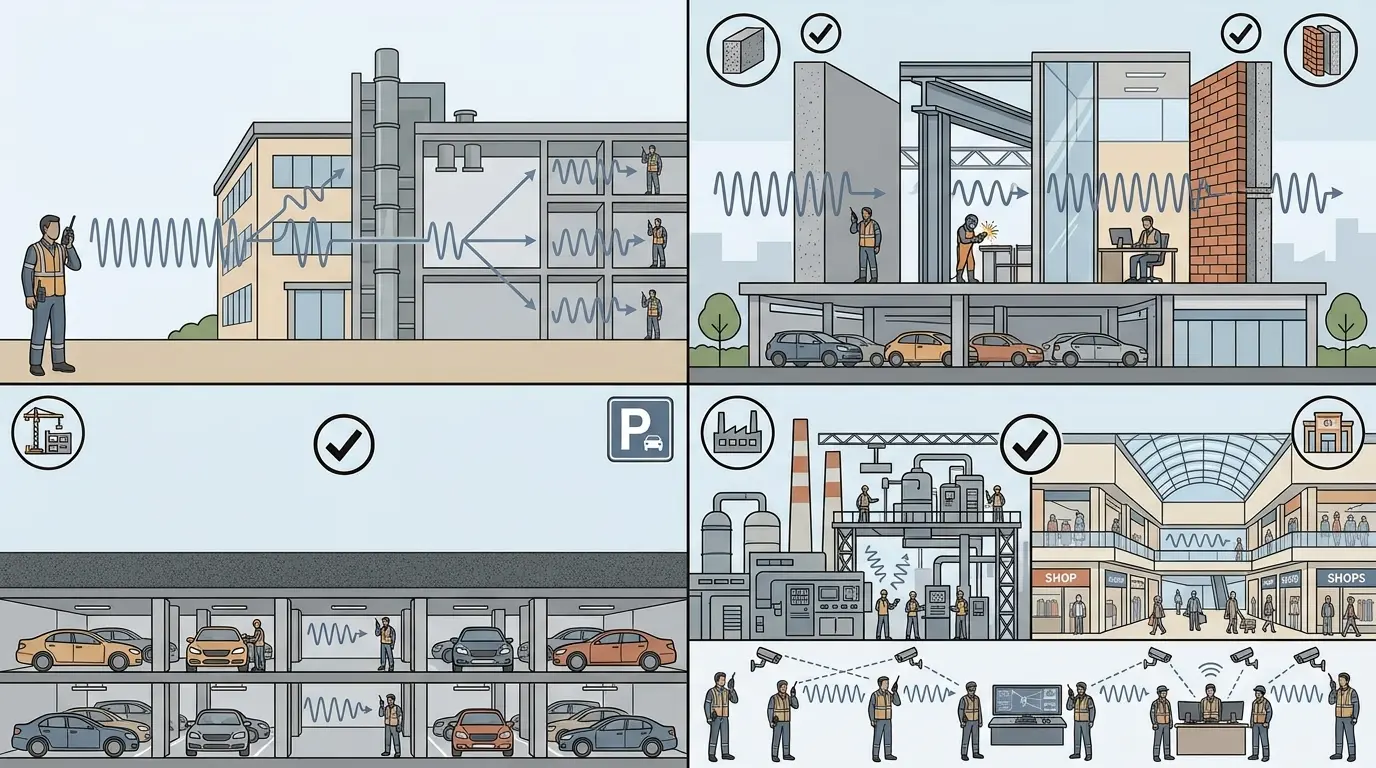
With shorter wavelengths, UHF signals have an excellent ability to penetrate physical structures. Their waves pass more easily through reinforced concrete, metal structures, glass, and heavy partitions. UHF is therefore the essential technology for factories, industrial complexes, shopping centers, construction sites, underground parking lots, and the private security sector.
In what cases should you prioritize the VHF band in the field?
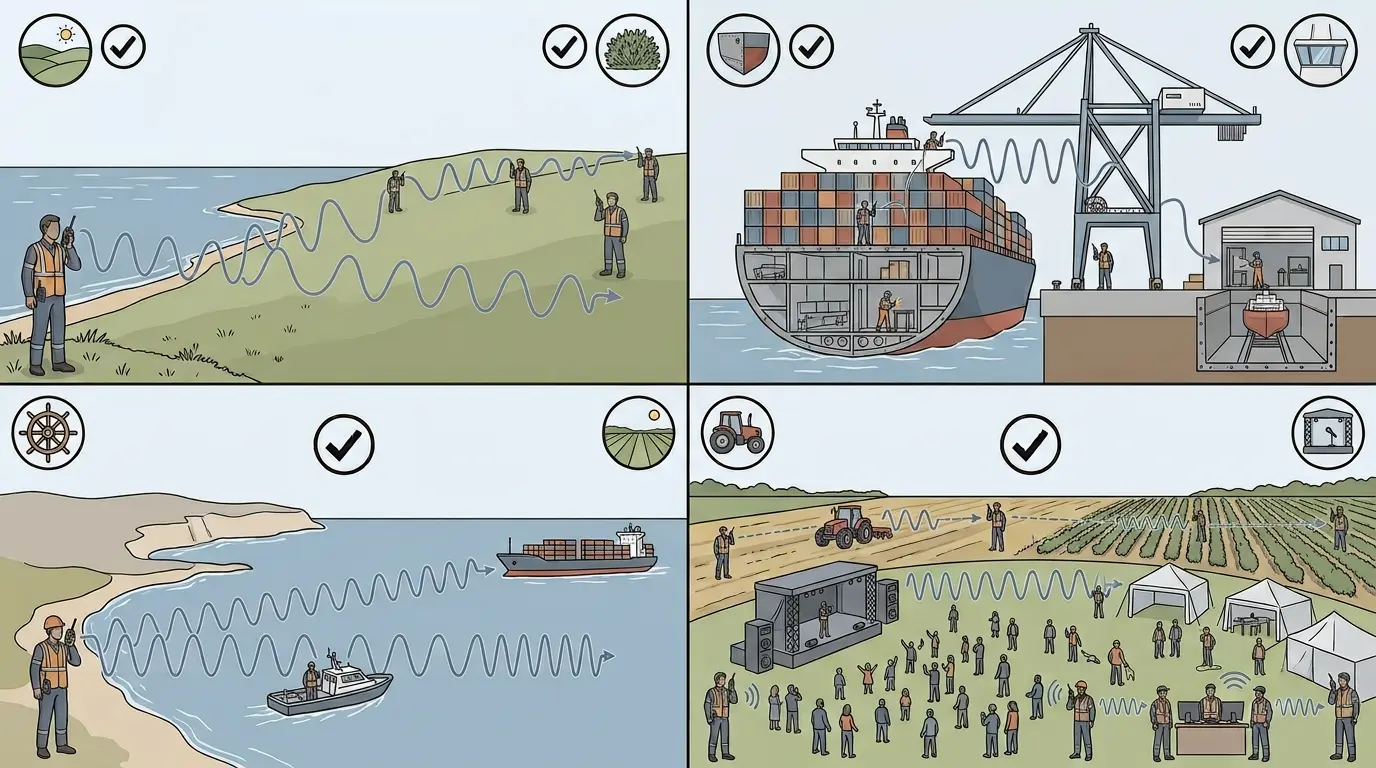
VHF waves, which are longer (about 2 meters in the 150 MHz band), propagate closer to the ground and better bypass natural obstacles like vegetation or gently rolling terrain. In open outdoor areas without major artificial structures, VHF offers greater range at the same power level. It is particularly recommended for the agricultural sector, forestry, shipyards, the maritime industry, and outdoor events.
Is it possible for a UHF radio to communicate with a VHF radio?
No, a purely UHF portable radio cannot directly transmit or receive on a VHF frequency, as the internal components and antenna are tuned to physically incompatible wavelengths. To allow two fleets operating on different bands to interact, you must set up a cross-band gateway or deploy hybrid receivers configured by an authorized radio installer.
How do you choose the right frequency for your professional radio fleet?
The choice between UHF and VHF depends not only on your preferences but on the exact topography of your operating site. The wrong frequency band immediately leads to dead zones and communication loss. Before any deployment, conducting a coverage test (field study) allows you to measure the actual signal attenuation on your site and select the appropriate terminals and frequencies.
Why choose TRPS for the management and allocation of your frequencies?
Based in Le Havre and operating throughout France and internationally, TRPS (Talkie & RadioPhony Solutions) masters the entire radio chain, from ANFR regulatory requirements to the technical configuration of your Motorola terminals. We conduct your site's coverage study, define the ideal band (UHF, VHF, or LTE/WAVE), and handle the licensing of your frequencies. Contact the TRPS team today to secure and optimize your company's radio network.
Ready to optimize your field communications?
Need to streamline your team's communications or keep your lone workers safe? Whether you need an urgent rental, an on-site coverage study, or a free demonstration, we are here to help you design the perfect solution for your operational needs.